
Embed Risk Management into every Supplier Relationship
Benchmark your current supplier management against hundreds of organisations worldwide to identify strengths and weaknesses in your operation. You will receive a detailed benchmark report that you can use to support your business case for change and identify what to focus on.

Embed Risk Management into Every Supplier Relationship
Benchmark your current supplier management against hundreds of organisations worldwide to identify strengths and weaknesses in your operation. You will receive a detailed benchmark report that you can use to support your business case for change and identify what to focus on.
Enable Proactive Risk Management
Traditional risk strategies often rely on compliance checklists, static assessments, or delayed responses. But in reality, risk exposure can escalate quickly and quietly. Smarter risk management starts with visibility, collaboration and capability. These are the three most important areas to focus on to reduce disruption and build resilience across your supplier network.
Segment suppliers by risk and criticality
Applying the same approach to every supplier creates blind spots and spreads risk management efforts too thin.
Focusing on the suppliers that matter most based on their exposure, impact, and criticality helps you target resources where they’re needed most and reduce the chance of being caught off guard.
Plan for risk together with suppliers
Risk planning often happens in silos, without input from the suppliers who are most affected when things go wrong.
Bringing suppliers into the process early creates shared visibility, stronger contingency planning, and faster, more aligned responses when disruption hits.
Build capability to spot risk early
Having access to risk data is one thing, knowing how to act on it is another.
Equipping teams to assess supplier risk, ask the right questions, and lead confident conversations helps identify issues sooner and prevent escalation.
Traditional risk strategies often rely on compliance checklists, static assessments, or delayed responses. But in reality, risk exposure can escalate quickly and quietly. Smarter risk management starts with visibility, collaboration and capability. These are the three most important areas to focus on to reduce disruption and build resilience across your supplier network.
Enable Proactive Risk Management
Segment suppliers by risk and criticality
Applying the same approach to every supplier creates blind spots and spreads risk management efforts too thin.
Focusing on the suppliers that matter most based on their exposure, impact, and criticality helps you target resources where they’re needed most and reduce the chance of being caught off guard.
Plan for risk together with suppliers
Risk planning often happens in silos, without input from the suppliers who are most affected when things go wrong.
Bringing suppliers into the process early creates shared visibility, stronger contingency planning, and faster, more aligned responses when disruption hits.
Build capability to spot risk early
Having access to risk data is one thing, knowing how to act on it is another.
Equipping teams to assess supplier risk, ask the right questions, and lead confident conversations helps identify issues sooner and prevent escalation.
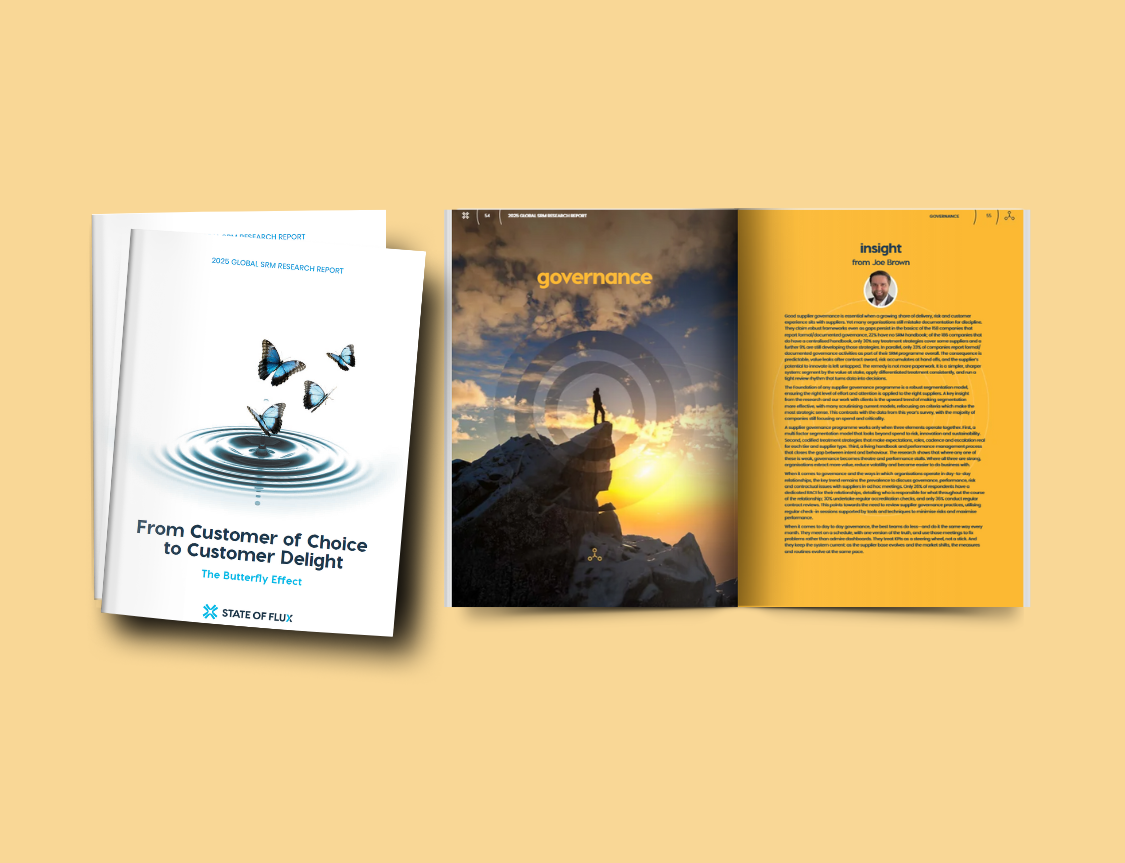
Exclusive insights from 335+ organisations shaping supplier management best practice.
Global SRM Research Report
Now in its 17th year, the Global SRM Research Report remains the most comprehensive study of supplier management worldwide. This year’s edition explores how supplier relationships shape customer experience, and why leading organisations are reframing SRM as an enterprise-wide capability rather than a procurement exercise.
The report examines the shift from being a customer of choice to achieving true customer delight, supported by insights on trust, loyalty, governance, capability building and the role of senior leadership. With findings from 484 respondents across 335 organisations, plus case studies from Aon, Air Canada, Vodafone, Currys and more, it offers practical guidance for teams looking to strengthen performance, resilience and innovation through their extended enterprise.
Our approach to smarter Risk Management
We believe effective risk management starts with proactive supplier relationships, not just reactive controls. Our approach helps you embed risk thinking into supplier collaboration, internal behaviours, and governance, so that risk becomes a shared priority, not just a procurement responsibility.

-
Benchmark your supplier management and receive a free report comparing your operations with those of hundreds of leading organisations worldwide. These insights provide a valuable perspective on your strengths and weaknesses, and support stakeholder buy-in for your future initiatives.
-
Start by segmenting suppliers based on risk exposure, business impact, and criticality. We help map your extended enterprise to identify concentration risks, sub-tier vulnerabilities, and supplier interdependencies.
-
Strong risk management depends on supplier transparency and trust. We facilitate supplier feedback conversations, joint workshops, scenario planning, and ongoing collaboration to turn risk from a compliance task into a shared agenda.
-
Risk tools are only effective when your teams know how to use them. We provide practical training in supplier risk assessment, risk conversations, and contingency planning to build long-term capability.
-
We help you define what good looks like for supplier risk management in your organisation and then co-create a roadmap to get there, aligning technology, behaviours, and governance with your long-term strategy.
Contact us to talk about your current challenges and explore how we could help you.

Risk Management and Cost Management: one integrated solution
Cost and risk management are deeply connected. The same supplier management frameworks that drive sustainable cost outcomes also create stronger supplier engagement, transparency and shared accountability—laying the foundation for proactive risk management.
Our modular approach allows CPOs to build capability in both areas, either independently or as part of a fully integrated supplier management transformation.

Explore Risk Management in practice
Take a deeper look at how leading organisations are reducing disruption and improving resilience through strategic supplier collaboration, backed by real-world examples and expert insight.




-
Start by segmenting suppliers based on criticality and risk impact. Then, map dependencies across your extended enterprise, including Tier 2 and Tier 3 suppliers. Tools like SupplierBase and structured supplier engagement frameworks can help surface hidden risks early.
-
Risk management should be collaborative, not one-sided. Through joint business planning sessions, scenario workshops, and ongoing supplier dialogue, you can create shared accountability and strengthen your ability to respond to disruption together.
-
Resilience and cost are not mutually exclusive. The same supplier management best practices that deliver sustainable cost outcomes, like segmentation, trust-based relationships, and data-driven performance, also reduce the cost of failure by preventing disruption.
-
Effective risk management relies on clear governance structures, cross-functional alignment, and behaviour change. This includes formal escalation paths, early warning systems, and tools that enable transparency across Procurement, Risk, IT, Finance, and Operations.
The first step is to assess your current situation by benchmarking your supplier management in general or getting a detailed diagnostic.
-
State of Flux offers practical training in SRM and risk management to help teams lead risk conversations, interpret supplier data, and act decisively. Capability development is key to moving from reactive to proactive risk management.
-