
From Customer of Choice to Customer Delight

State of Flux research consistently shows that suppliers are responsible for up to 50% of the end-customer experience. That means most organisations rely on suppliers to deliver half of their customer experience. However, too few manage these relationships strategically. This results in a lost opportunity to turn satisfied customers into delighted ones.
And this matters, because ‘delight’ drives overall business success. Don’t just take it from us. Warren Buffett, one of the world’s best known and most successful investors, says it himself: “Don’t just satisfy your customers, delight them!” (Buffett, 2016).
“Delighting a customer encourages repeat business, delighting a supplier encourages discretionary effort.”
To play its part, procurement needs to shift its focus upstream. It should move from understanding supplier impact on the customer journey to influencing supplier behaviour through respect, loyalty and trust. If the customer journey defines the ‘what’ of experience delivery, then being a customer of choice defines ‘how well’.
Influencing the influencers
For some businesses, more than half of their workforce is employed indirectly through its supply base. Logistics partners, outsourced service centres, component manufacturers and call-centre operators, for example, all play a role in shaping a customer’s impression of a brand. Some even represent it directly. Their performance shapes customer perception. Their innovation drives your competitiveness. Their effort determines how well your promises are delivered.
These experiences are not simply functional, they are emotional. In a competitive market, the difference between customer retention and churn is often defined by the ability to surprise and delight.
‘Delight’, as Barnes and Krallman define it, goes beyond satisfaction. It is the emotional high that provides joy or surprise when expectations are not only met, but exceeded, whether as a result of speed, quality, flexibility or innovation (Barnes et al., 2020). Delight is not just a feeling, it drives business performance.
Customers who are delighted are more loyal and more likely to advocate for you. This means that their opinion is worth money. Findings published in the Journal of Consumer Research show that companies that consistently exceed expectations generate stronger emotional bonds, leading to higher retention and advocacy rates (Sashi et al., 2019). Buffett says any business that has delighted customers has an unpaid salesforce because delighted customers will drive business growth through word-of-mouth (Buffett, 2016).
And they will spend more too. According to a study published in the Journal of Marketing, emotionally engaged customers are three times more likely to recommend a product and repurchase, and they spend up to twice as much annually as satisfied customers (Bozkurt et al., 2022). Another study showed delighted customers in the grocery retail sector increased spend by up to 15% (JLL, 2025). So delight is measurable too.
Yet these outcomes are often delivered by people who do not work directly for your business. Suppliers, be they your delivery agents, product engineers or cleaners, are often the face of your brand. When they feel engaged, empowered and loyal, they go beyond what’s expected and can create moments of joy and surprise that customers remember. Your role is to motivate them to do so.
““The people who manage the outcomes of procurement decisions are often not in procurement.”
Customer of choice
Suppliers are under no obligation to go the extra mile. In fact, many won’t, unless they consider you worth the effort. Our research shows that when organisations are viewed as a customer of choice, suppliers are more willing to share innovation, provide access to scarce resources, offer better terms and assign their best talent. They help you to get new products to market sooner, solve problems faster, and are more collaborative in driving change. In short, they help you to delight your customers.
Luxury brands offer a striking example. In earlier research, we found that while many luxury organisations lacked SRM process maturity, they excelled at the human side of relationship management: trust, loyalty and collaboration. These brands understand that delighting customers starts long before the product reaches the end user.
They actively cultivate supplier loyalty using tactics that parallel their consumer loyalty strategies. They listen to suppliers both formally through customer of choice measurements and informally through genuine personal interaction. Some invite strategic suppliers to internal training, customer events or even co-designing sessions.
Brands such as McLaren Automotive and Harley-Davidson ensure their suppliers feel like part of the team, or part of their extended enterprise. Others, like motor yacht brand Sunseeker and high-end headphones, speaker and television company Bang & Olufsen, reinforce loyalty with trust-building behaviour such as respect, recognition and mutual feedback. This generates greater innovation, faster problem-solving, and a willingness among suppliers to push boundaries in pursuit of shared goals.
Just as delighting a customer encourages repeat business, delighting a supplier encourages discretionary effort. That discretionary effort is what shows up in the customer experience.
The role of SRM
This is where SRM comes in. It is too often regarded as a procurement tool for managing performance, compliance and cost. In reality, it should be seen as a cross-functional capability that enables business success.
The best-performing organisations treat SRM not as an operating necessity but as a strategic lever. They segment their suppliers not just by spend or risk, but by their impact on customer outcomes, access to innovation and whether the supplier sees them as a strategic customer. They co-create KPIs that reflect service, quality, innovation and responsiveness. They align procurement metrics with brand values and customer experience targets, and they invest in training, tools and governance to ensure these relationships deliver something better than expected.
If delighting customers is a board-level priority, and it should be, then managing supplier relationships ought to be treated with similar importance. The pathway to competitive advantage may not lay in your own organisation, but in the extended enterprise that serves your customers every day.
According to Kano’s model of customer satisfaction, developed by Professor Noriaki Kano, it is not the absence of failure but the presence of features that provide delight, the unexpected, value-added moments, that build customer loyalty.
Review your customer journeys and you will see that it is your suppliers who enable many of those moments. To become a business that consistently delivers delight, you must start by becoming a customer of choice for your suppliers. They are not just vendors, they are brand ambassadors at the frontline of your extended enterprise and they should be treated as such.
Make them feel valued, trusted and included, and they will deliver more than products and services. They will deliver business results.
As Buffett says: “If you delight your customers, you’ll make a lot of money.” If you want suppliers to help you delight your customers, start by becoming a customer they choose to prioritise.
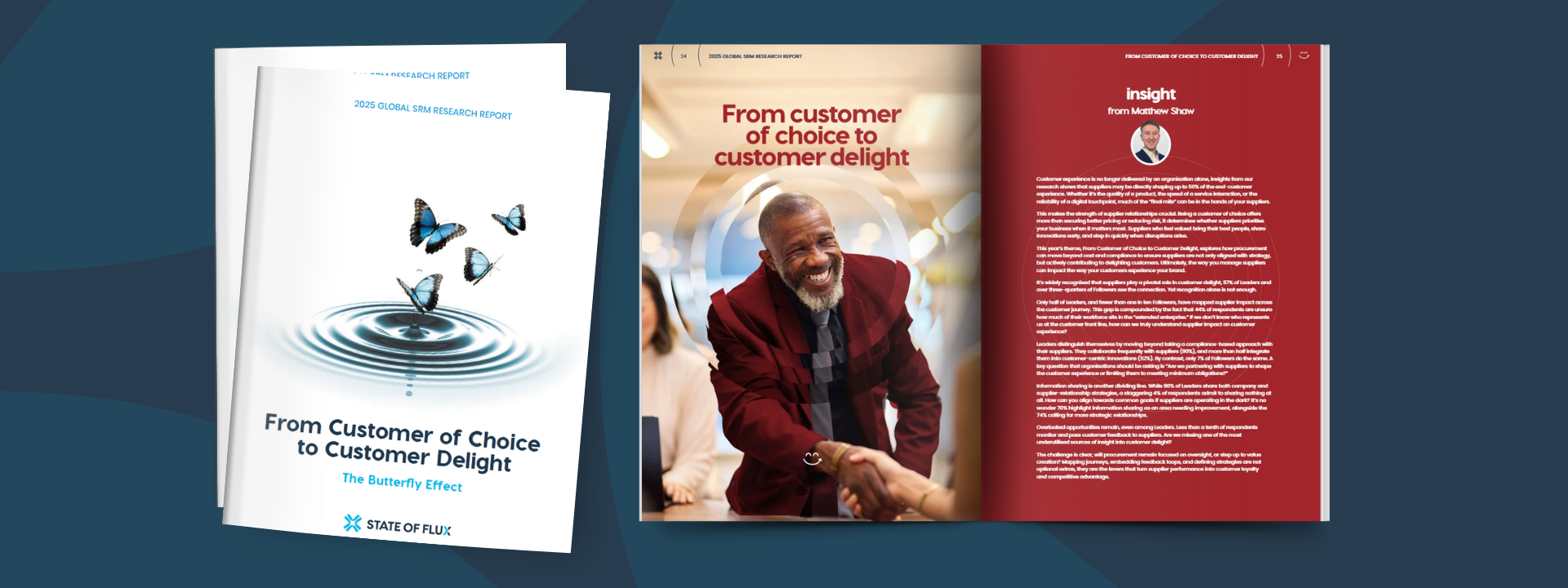
2025 Global SRM Research Report
See what the latest SRM research reveals about supplier relationships, Customer of Choice and the impact suppliers have on customer experience. Explore the findings, benchmarks and case studies in the 2025 Global SRM Research Report.
